

A Message from the Dean
Welcome to the website of the Akita University Graduate School of Medicine and the School of Medicine
History and Mission
The School of Medicine at Akita University was established in 1970 as the first new medical school created in Japan after World War II. Its founding was driven by the strong will of the people of Akita Prefecture, who supported the transfer of the former Prefectural Central Hospital to the national government to serve as the university hospital.
The School of Health Sciences began in 1972 as the Nursing School attached to the university hospital. It later became the Akita University College of Allied Medical Sciences in 1989 and was reorganized into the School of Health Sciences (a four‑year program) in 2002.
In 2009, with the transition to a graduate‑school‑centered university structure, the School of Medicine was reorganized as the Graduate School of Medicine, consisting of the Medical Sciences Program and the Health Sciences Program. Since its establishment, the Graduate School and School of Medicine have produced approximately 5,200 graduates who now play leading roles across various fields of healthcare.
Building on this history, the School of Medicine and the University Hospital have earned deep trust through their contributions to regional healthcare in Akita and beyond. We are committed to advancing cutting‑edge medical care and world‑class research while fulfilling our vital mission of protecting the health and well‑being of the people of Akita Prefecture. Below, we outline our major initiatives in education, research, and clinical practice.
Education
The curriculum of the School of Medicine is known nationwide for its innovative approach, often referred to as the “Akita Model,” which provides seamless, integrated education from undergraduate to postgraduate training. Beginning with early clinical exposure in the first year, students engage in clinical training throughout their six years of study, supported by the full cooperation of the Akita Medical Association and healthcare institutions across the prefecture.
In 2001, we became the first in Japan to introduce the Post‑Clinical Clerkship Objective Structured Clinical Examination (PCC‑OSCE), an objective skills‑based assessment conducted at graduation. Through such initiatives, we have built a unique educational and evaluation system.
The School of Health Sciences also offers diverse clinical training opportunities in collaboration with local healthcare institutions and municipalities, and emphasizes small‑group, student‑centered education.
Our Simulation Education Center, located on the Hondo Campus, is open not only to students but also to healthcare professionals throughout the prefecture, serving as a valuable facility for hands‑on training. We are also actively developing and implementing new educational methods, including English‑language medical interview training from the first year, student web systems, e‑learning, and digital education tools, all designed to support effective and motivated learning.
In 2023, we established the Department of Advanced Digital Medicine and Medical Education, which aims to further enhance education through the use of emerging technologies such as AI.
As a result of these efforts, our students consistently achieve excellent outcomes on national examinations, with the pass rate for the National Medical Licensing Examination ranking among the highest in Japan. In 2021, we also received high evaluations in the field‑specific assessment conducted by the Japan Accreditation Council for Medical Education.
International exchange is another strength. We actively accept international students, and the School of Medicine currently offers short‑term study‑abroad programs at ten partner universities overseas. Supported by the Medical School International Exchange Fund, many students take advantage of these opportunities. The School of Health Sciences also maintains active student exchange programs with eight universities, including the National University of Singapore.
Research and Clinical Practice
The Graduate School of Medicine conducts advanced and distinctive research across a broad spectrum—from basic science to clinical medicine—and continues to share its achievements with the world.
In cancer research, active studies include tumor microenvironment analysis, development of new therapies for hematologic and solid tumors, pharmacogenomics, mechanisms of cell death, and the relationship between obesity and cancer progression. Significant progress is also being made in fields such as sleep molecular biology and immunology/allergy research.
In infectious disease research, the Comprehensive Infection Control Center plays a central role in integrating clinical, epidemiological, and basic research.
In 2025, we established the Clinical Research Physician Development Center to create an environment that enables physicians and researchers to participate more easily in research. This center will also allow undergraduate students to join research activities as student assistants, helping cultivate future physician‑scientists.
We are also actively promoting medical‑engineering collaboration. Examples include the advancement of telemedicine through the University Hospital’s Medical DX Center and the development and practical application of automated rapid pathological diagnostic systems for cancer.
Clinically, the University Hospital serves as the only advanced treatment hospital (tokutei kinō byōin) in Akita Prefecture, providing high‑quality, cutting‑edge medical care.
In 2020, the General Practice Center was established to strengthen the training of physicians with comprehensive clinical skills who will support regional healthcare.
In 2021, the Advanced Critical Care and Emergency Center was opened, significantly enhancing our capacity for ultra‑acute care, including limb replantation and multidisciplinary treatment for severe trauma.
We are also committed to advanced surgical care, including robot‑assisted minimally invasive surgery, cardiovascular surgery in hybrid operating rooms, and spine surgery using navigation systems.
In cancer treatment, our hospital handles the largest number of cases in the prefecture.
Through these efforts, the University Hospital fulfills its role as the final stronghold of medical care for the people of Akita while also contributing greatly to the education and training of future healthcare professionals.
Closing Remarks
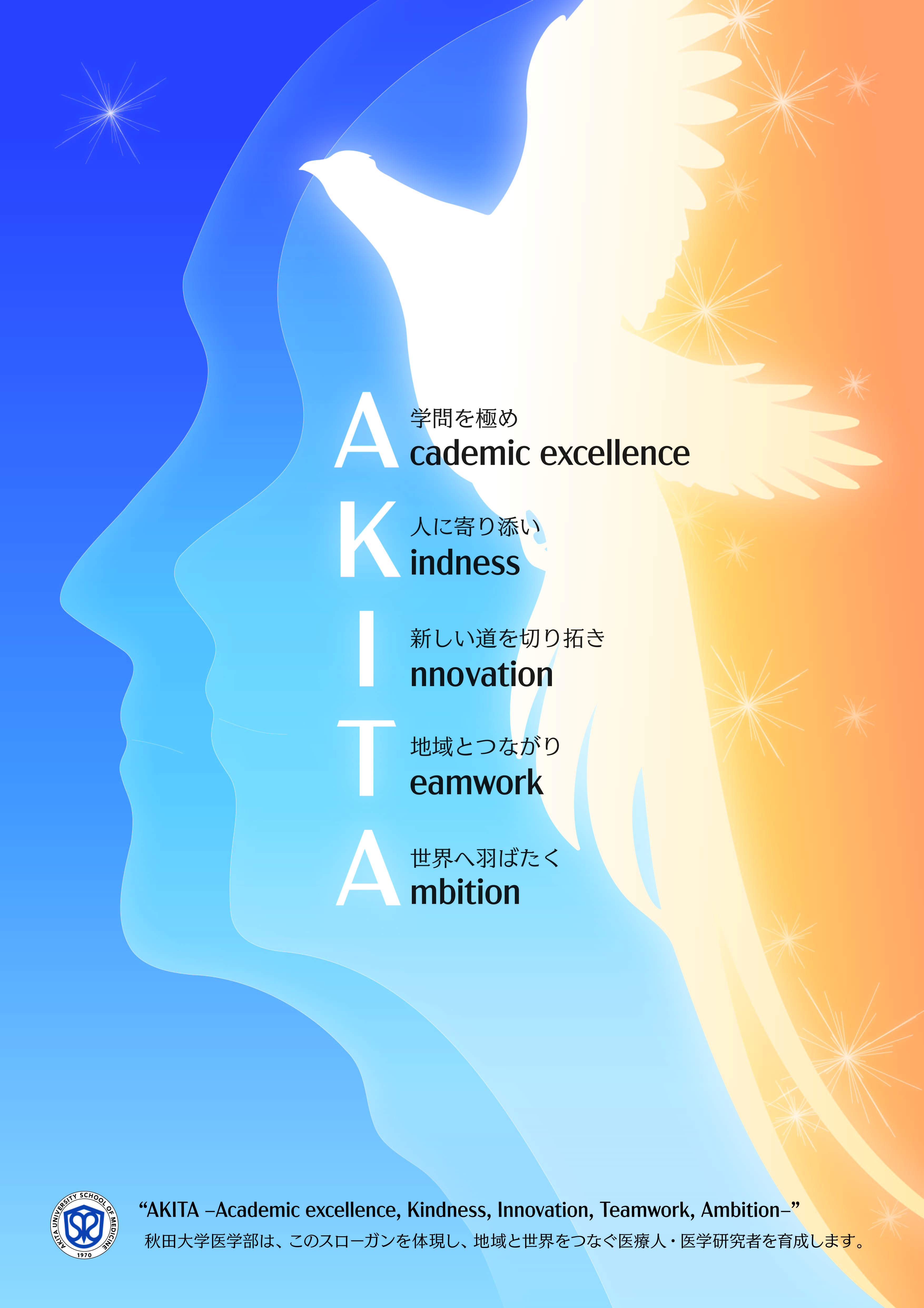
The School of Medicine will continue to promote its newly established slogan:
AKITA – Academic excellence, Kindness, Innovation, Teamwork, Ambition
(“Pursue academic excellence, care for people, pioneer new paths, connect with the community, and reach out to the world.”)
Through our commitment to excellence in education, research, and clinical practice, we aim to embody this philosophy and foster medical professionals and researchers who will connect Akita with the world.
We sincerely hope that many students and graduate students will join the School of Medicine and the Graduate School of Medicine at Akita University, help shape the future, and thrive as members of our academic community.
Naohisa Miyakoshi, M.D., Ph.D.
Dean, Graduate School of Medicine